
Data for the People: 2026 Policy Agenda

Publication Date

April 2, 2026

Topics

Share

Overview

California cannot close opportunity gaps or improve student outcomes without modern, transparent, and interconnected data systems. The Data 4 The People (D4TP) Coalition—a statewide coalition of education and workforce advocates, co-chaired by EdTrust-West and Young Invincibles, working across early childhood, TK–12, higher education, and workforce development—developed the 2026 Policy Agenda to address the most urgent data gaps facing communities, advocates, and policymakers. 

This agenda outlines actionable steps state leaders can take to strengthen the Cradle-to-Career (C2C) Data System, improve reporting across agencies, and ensure all Californians have access to timely, disaggregated data that drives accountability and supports better outcomes.

Key Takeaways


  • The 2026 Policy Agenda proposes seven statewide priorities that strengthen data infrastructure from early learning through the workforce.
  • Recommendations focus on equity, transparency, and cross-agency alignment, ensuring communities get the information they need to advocate for better outcomes
  • Strengthening data systems is essential for targeting resources, supporting multilingual learners, improving dual enrollment access, and tracking education-to-workforce pathways.
  • The agenda also calls for implementing the newly established California Interagency Council as an accountable, cross-agency driver of shared standards, definitions, and improved statewide reporting

What You'll Find in These Resources

1. 2026 Policy Agenda — Three-Pager

A comprehensive overview of all seven priority areas,  including:

  • Multilingual learner (MLL) data 
  • Dual enrollment data
  • Interagency Council implementation

  • Student debt reporting

  • Workforce data integration and dashboards

This version includes background context, rationale, and recommended next steps for policymakers.

2. 2026 Policy Agenda — One-Pager

A streamlined summary perfect for:

  • Legislative meetings
  • Partner sharing
  • Public presentations
  • High-level advocacy and communications

Call to Action

The D4TP Coalition is mobilizing partners across California
to advance policies that strengthen data access, improve transparency, and
build education and workforce systems that truly serve all communities. 

You can help drive change by:

  • Sharing these resources with policymakers, community leaders, and partners.

  • Advocating for state investments in interconnected, equity-focused data systems.

  • Engaging with the D4TP Coalition to stay informed and support advocacy efforts.

  • Joining the coalition’s email list for updates, action alerts, and partnership opportunities.

Get Involved

Visit hwww.eddataforthepeople.org/ to:

  • Join the D4TP email list
  • Explore the coalition’s work
  • Connect with partners
  • Learn about upcoming advocacy opportunities 

For partnership inquiries, contact: Roy Tongilava.

Latest Resources

Building What We Deserve: EdTrust-West’s Vision for Education Equity in Los Angeles County

At EdTrust-West, we believe every student in LA County deserves access to high-quality, equitable education that prepares them for college, career, and a future of their choosing. In this pivotal moment, we call on education leaders to take bold action—and we stand ready to partner with communities to make this vision a reality.

EdTrust-West | September 3, 2025

Dual Enrollment Practitioner Guides

Dual enrollment is gaining momentum in California as a key strategy for advancing education equity. To help ensure access for Black, Latinx, and Native American students, EdTrust-West and Career Ladders Project created three Practitioner Guides focused on coordination, recruitment, and counseling.

EdTrust-West | September 28, 2025

04/02/2026

Data for the People: 2026 Policy Agenda

California cannot close opportunity gaps without modern, interconnected data systems. The Data for the People Coalition’s 2026 Policy Agenda outlines seven statewide priorities to improve education and workforce data—from early learning through employment—so communities, advocates, and policymakers have the information they need to drive equity and accountability.
03/18/2026

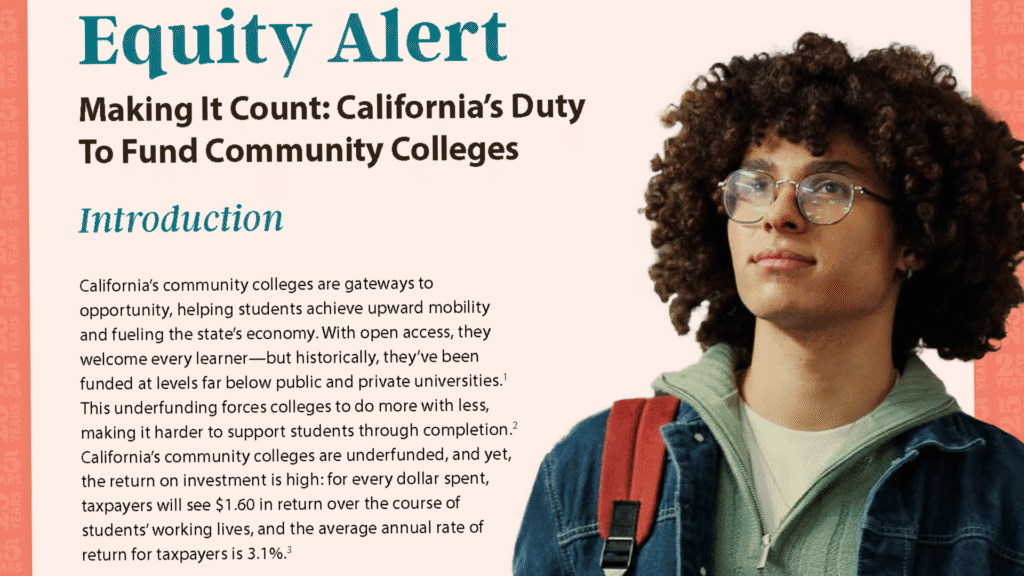
Making It Count: California’s Duty To Fund Community Colleges

California’s community colleges are gateways to opportunity, helping students achieve upward mobility and fueling the state’s economy. Yet for decades, they’ve been funded at levels far below public and private universities—forcing colleges to do more with less and making it harder to support students through completion. With the ‘hold harmless’ provision ending, the 2025–26 year marks the first real test of whether the Student Centered Funding Formula can deliver the equitable funding California’s students deserve
02/04/2026

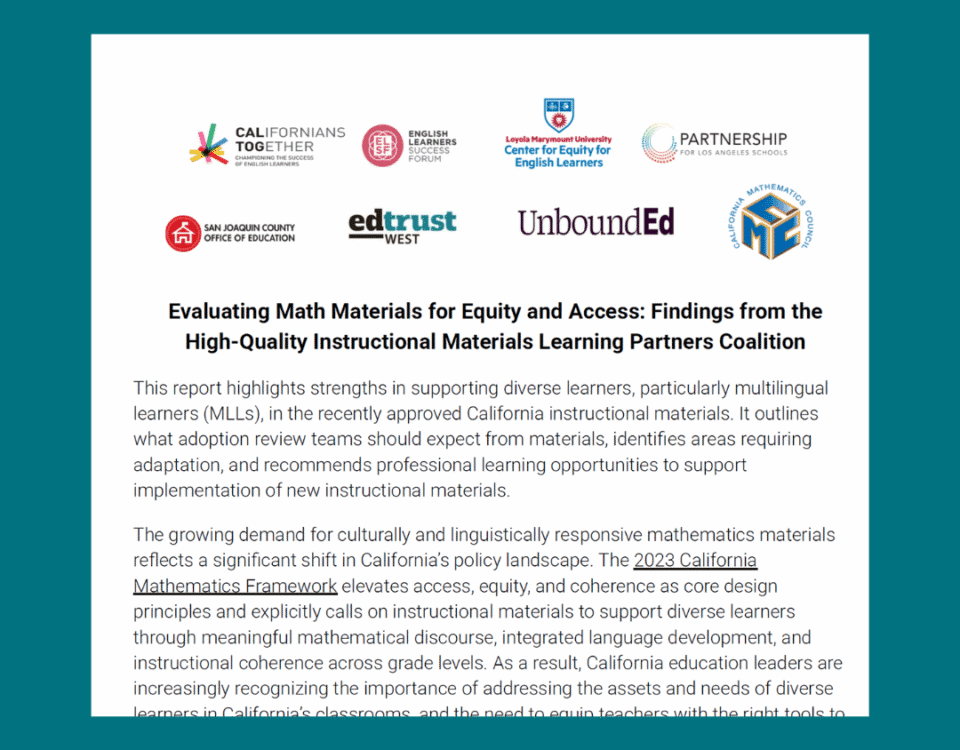
Evaluating Math Materials for Equity and Access: Findings from the High-Quality Instructional Materials Learning Partners Coalition

This analysis of K–8 mathematics instructional materials highlights promising developments in supporting multilingual learners as well as key areas where publishers and districts must strengthen language development, cultural relevance, and teacher guidance. The findings offer actionable insights for LEAs preparing for California’s 2025 math adoption and point to free tools that can support more equitable decision‑making.
12/05/2025

Implementing Data-Driven Policy Solutions for California’s Early Learning and Care System Transformation

California is at a pivotal moment in transforming its early learning and care system. The state has laid the groundwork for an Early Childhood Integrated Data System (ECIDS) to ensure every child from birth to age five has equitable access to high-quality programs
11/10/2025

Empowering Futures: Improving College Access for Multilingual Learners

EdTrust-West’s latest policy brief, Empowering Futures: Improving College Access for Multilingual Learners, which outlines five key recommendations to close equity gaps and expand higher education opportunities for California’s multilingual learners.