
Teaching Assignment Monitoring Outcomes (TAMO) Data Dashboard
Introducing the TAMO Data Dashboard
Tackling the teacher shortage in California goes hand-in-hand with our commitment to ensuring the state is enhancing educator diversity, recruitment, and retention. Especially when we consider the pivotal role of educators of color in creating inclusive learning environments and boosting student achievement, we know that it’s not just about quantity, but quality. Our state needs not only more teachers, but we need the right teachers, meaning teachers who are well-prepared to support their students to succeed. We are proud to introduce the Teaching Assignment Monitoring Outcomes (TAMO) Data Dashboard, which provides a first-ever look at data on teacher preparedness to understand how well-prepared teachers in classrooms are across the state.
About This Tool
This tool uses data released by the California Department of Education (CDE) on teacher preparation and what classes and students they are assigned to teach across the state’s schools via the Teaching Assignment Monitoring Outcomes dataset. The annual release of these data comes after years of relentless advocacy, and can be a very useful tool for ensuring all of California’s students are taught by well-prepared and appropriately assigned teachers. Such increased transparency allows educational leaders and community stakeholders to engage in fruitful dialogues about equitable access to properly trained and assigned teachers.
We’ve taken the 2020-21 and 2021-22 data provided by CDE, paired it with student demographic data, and are presenting it in an interactive, visual tool, making it more accessible for educators, advocates, and families to examine the equity implications of teaching assignments.
Understanding Teaching Assignment Monitoring Outcomes (TAMO) Data
Research shows that teachers are the most important in-school factor impacting student learning. Ensuring access to effective teachers is one of the most powerful tools that exists to close equity gaps for students of color, students from low-income households, and multilingual learners.
A fully prepared teacher has:
- Comprehensive subject matter training and demonstrated proficiency in the subject(s) they will teach
- Completed an accredited teacher preparation program and demonstrated their effectiveness in teaching through a performance assessment
- Completed at least 600 hours of student teaching
- Earned a credential in either multiple subjects, single subjects, or specialized education

What do we mean by how teachers are "assigned"?
Being fully prepared doesn’t necessarily translate to being appropriately assigned.
A “Clear”* status in the context of these data indicates a teacher who is both fully prepared (having completed all necessary subject matter training) and appropriately assigned, ensuring they teach the students and the content area for which they’re credentialed. We know students benefit from having a “Clear” status teacher, but thanks to the new teaching assignment data, we also know that, unfortunately, students across California’s schools and districts face equity gaps in terms of access to these teachers. School districts serving the most students from low-income households have lower rates of “Clear” teaching assignments than schools with the fewest of these students. Digging into the data also reveals that within districts, schools with the highest proportions of students of color and students from low-income households have less access to fully prepared and properly placed teachers.
Every student in California deserves to be taught by fully prepared and appropriately assigned teachers. We’ll continue to share our findings on equitable access to these educators. In addition, we’re equipping community members, advocates, educators, and policymakers with this tool so that they can explore the data themselves. So, where does your school, district, or county stand? See the interactive tool below to begin exploring the data.
A “Clear”* status in the context of these data indicates a teacher who is both fully prepared (having completed all necessary subject matter training) and appropriately assigned, ensuring they teach the students and the content area for which they’re credentialed. We know students benefit from having a “Clear” status teacher, but thanks to the new teaching assignment data, we also know that, unfortunately, students across California’s schools and districts face equity gaps in terms of access to these teachers. School districts serving the most students from low-income households have lower rates of “Clear” teaching assignments than schools with the fewest of these students. Digging into the data also reveals that within districts, schools with the highest proportions of students of color and students from low-income households have less access to fully prepared and properly placed teachers.
Every student in California deserves to be taught by fully prepared and appropriately assigned teachers. We’ll continue to share our findings on equitable access to these educators. In addition, we’re equipping community members, advocates, educators, and policymakers with this tool so that they can explore the data themselves. So, where does your school, district, or county stand? See the interactive tool below to begin exploring the data.
*This definition is not to be confused with the process of “clearing” a preliminary teaching credential through the completion of a Commission-approved General Education Induction Program.
Who Should Use This Tool?
This tool provides a comprehensive view of teacher preparedness and assignments, equipping various stakeholders with the insights they need to advocate for changes in policy and practice that ensure all students have access to fully prepared, effective teachers.
- Parents, Families, and Community Members: By accessing this information, families and community members can get a clearer picture of the qualifications of teachers in their children’s schools, which can inform their decision-making and equip them with information to advocate for change.
- Education Administrators: School and district leaders can analyze this data to optimize teacher placement and ensure students have equitable access to well-prepared educators.
- Policymakers: Decision-makers crafting educational policies and practices can use this data as a foundation for setting goals for improvement and targeting investments and supports in recruiting, hiring, and retaining fully prepared teachers.
The Tool
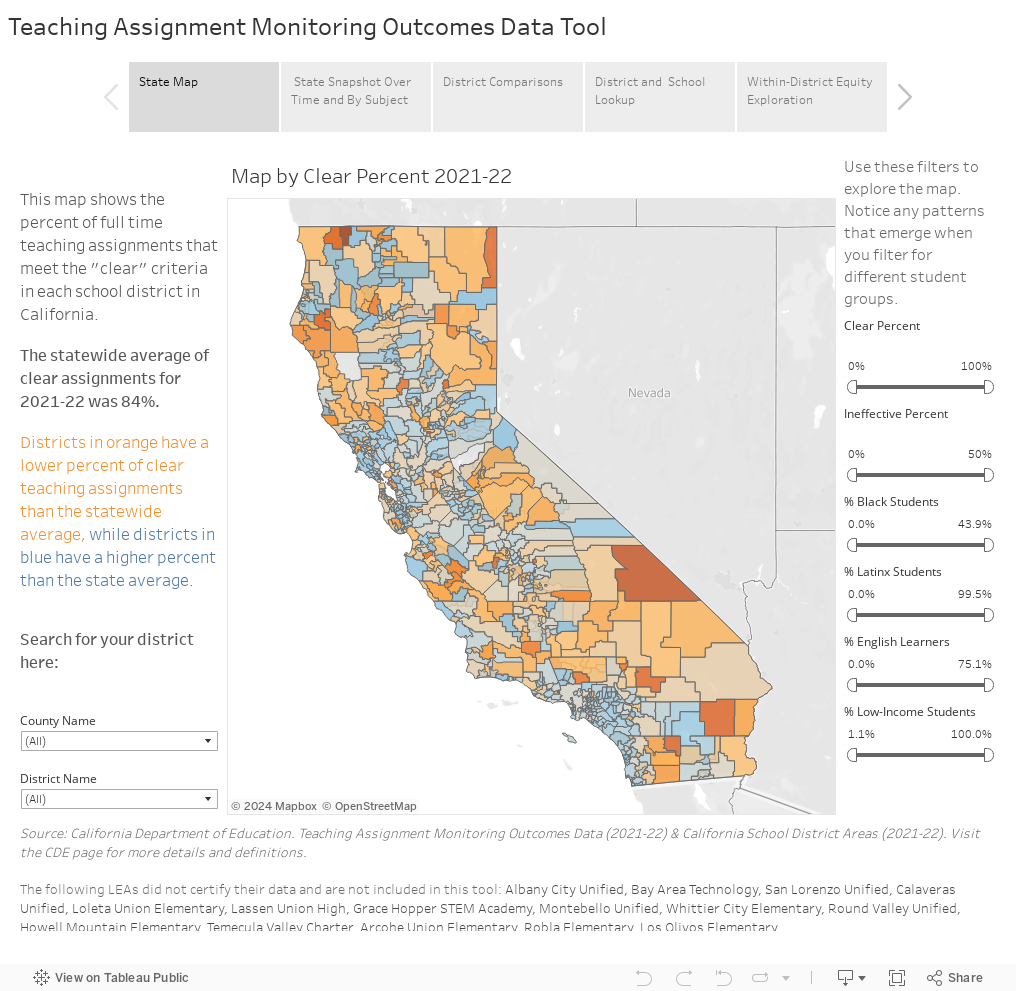
How to Use the Tool
This map displays the percentage of full-time teaching assignments deemed “Clear” across each school district in California. A “Clear” assignment means that a class is taught by a teacher with all of the appropriate credentials.
- During the 2020-2021 academic year, 83% of teaching assignments across the state were “clear”.
- During the 2021-2022 academic year, 84% of teaching assignments across the state were “clear”.
- Orange Districts: These have a lower percentage of clear teaching assignments than the state average.
- Blue Districts: These exceed the state average in terms of the percentage of clear assignments.
- Left-Hand Side Filters
- Scroll to the bottom left of the map.
- Search by location using filters like district type, county name, or district name.
- The “all” option allows you to search for and select one or multiple specific entities.
- Right-Hand Side Filters
- Search by “clear” assignments in specific school districts.
- Use filters to hide/show districts based on student group percentages served by the district.
- To reset any filters, click the red “X” over the funnel icon located on the upper right-hand side of any filter section.
- Use the dropdown list on the bottom-right of the tool to search by student demographics and use the filters below to show or hide districts based on the percentage of students that are in a given student group served by the district. Click the red “X” over the funnel icon in the upper right-hand side of any filter to clear the selection. You can search by percentage of low-income students, percentage of English learners students, percentage of students with disabilities, percentage of Black students, and percentage of Latino students
Video Guide
We’ve prepared a video guide for those who prefer a visual walkthrough or would like more detailed instructions.
Definitions
- ‘Clear’ Teaching Assignments: “Clear” teaching assignments are those where all relevant attributes or dimensions of a teacher placement are properly authorized. This typically means that the teacher holds either a clear or preliminary credential suitable for the content, student groups, or grades they’re instructing in a particular class or course section.
- ‘Out-of-field’ Teaching Assignments: “Out-of-field” teaching assignments are those where the teacher has a teaching credential but not for the subject of the class and is teaching with a limited permit.
- ‘Intern’ Teaching assignments: “Intern” teaching assignments are those where the teacher has an intern credential but has not yet completed a teaching program.
- ‘Ineffective’ Teaching Assignments: “Ineffective” teaching assignments are those where the teacher does not have the credentials or permit to teach the class.
- ‘Incomplete’ Teaching Assignments: “Incomplete” teaching assignments are those where there is missing or incorrect information.
Please visit the California Department of Education’s website for more information.
Training Webinar: Mapping Out Gaps In Teacher Preparation (10/17/2023)
Get Involved
We’re excited about the potential of the TAMO Data Dashboard to fuel equity-focused conversations and advocacy, and we want you to be part of this journey:
- Spread the word: Share information about the TAMO tool with your community, school, or organization.
- Feedback: Let us know your thoughts on the dashboard by completing this form.
- Use hashtags to share on social media about the assignments for schools and teachers in your district: #TAMODataDashboard

Credits & Acknowledgements
We are grateful to the organizations whose generous support and partnership have made the development of this tool possible:


Contact
If you have any questions, feedback, or inquiries about the data tool, please contact our Director of Research, Melissa Valenzuela-Stookey.